Will AI Data Centers Raise My Electric Bill? (2025)
AI data centers are pushing electricity costs up in some parts of the U.S.

Written by Hash Manesia
Published on Mar 4, 2026
|
7 min read
Reviewed by Hash Manesia, Kyle Aubuchon
Will AI Data Centers Raise My Electric Bill? (2025)
Why AI changes the grid
AI systems run in energy‑hungry data centers. A 2024 federal report shows U.S. data centers used ~176 TWh of electricity in 2023 (about 4.4% of all U.S. power). By 2028, usage could reach 325–580 TWh (about 6.7%–12% of U.S. consumption), depending on how quickly AI infrastructure expands. That is a step‑change in just five years. The Department of Energy's Energy
Figure 1 — U.S. data‑center electricity use (history & 2028 range)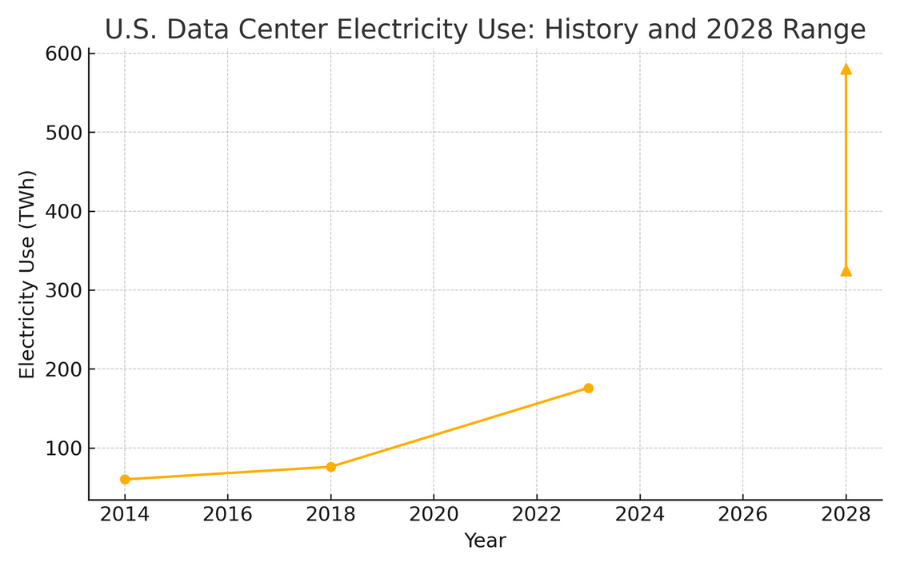 Data: U.S. DOE summary of LBNL (2024). The Department of Energy's Energy
The path from server racks to your bill
Think of your bill as three buckets:
- Energy — the electricity you actually use. Prices can rise if big new loads (like AI data centers) push demand up faster than plants are added. EIA’s outlook notes that commercial electricity sales rise in 2025–26 partly because of data centers. U.S. Energy Information Administration
- Capacity / Adequacy — what it costs to ensure enough power will be available on the hottest (or coldest) days. In PJM (Mid‑Atlantic/Midwest), this is priced in a forward auction. Those capacity prices have spiked as forecast demand (much of it data centers) outpaced supply. PJM
- Wires (T&D) — poles, wires, substations, and big transmission projects. Utilities from California to Texas are now planning tens of billions in new grid spending, citing large new loads (including data centers). Those investments typically go into rates unless regulators assign special charges to the large users. Reuters
What’s actually happening to bills right now?
PJM’s capacity cost spike (the clearest example today)
PJM’s recent auctions cleared at:
- 2024/25: $28.92 per MW‑day
- 2025/26: $269.92 per MW‑day
- 2026/27: $329.17 per MW‑day (the cap, in all zones) PJM
Figure 2 — PJM capacity prices (recent auctions)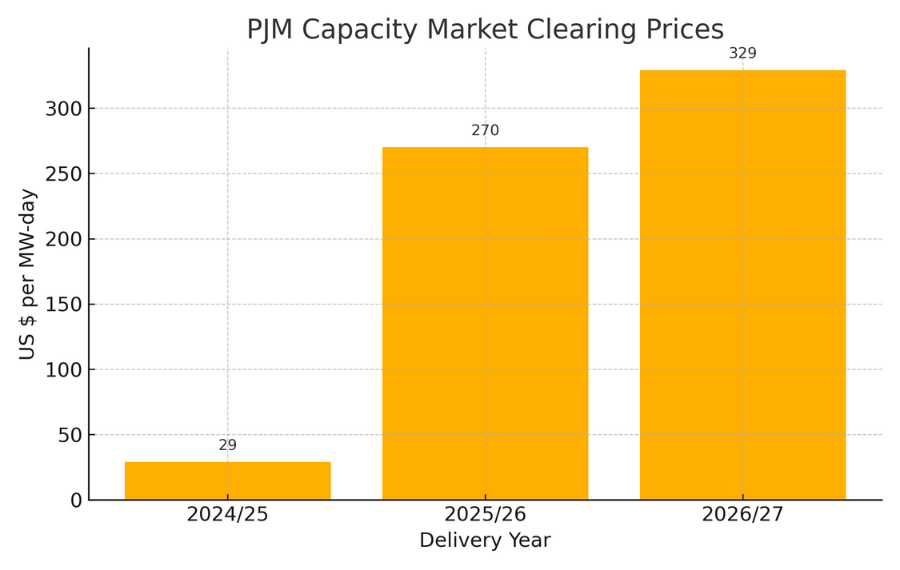 Source: PJM auction reports. PJM
PJM’s independent market monitor concluded that data‑center load growth is the primary reason for the tight conditions and high prices; its analysis attributes about $9.3 billion of the 2025/26 price jump to data centers alone. Monitoring Analytics
How that translates to households (documented examples):
Figure 3 — Illustrative monthly residential bill impacts from PJM capacity costs (2025–26)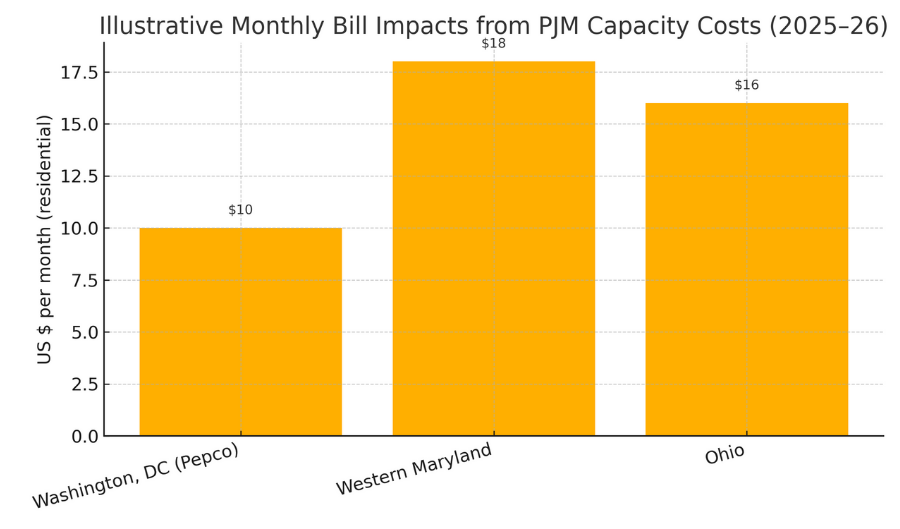 Source: IEEFA summary of local filings. IEEFA
Important context: Not every region uses a capacity market, and not every utility passes costs through the same way. U.S. average residential prices rose 6.2% from 2022 to 2023 (15.04 → 15.98 ¢/kWh) for many reasons (fuel, weather, wildfire hardening, etc.). AI is one of several new pressures. U.S. Energy Information Administration
Why your location matters
- In Texas (ERCOT): Load from “Large Flexible Loads” (including data centers) is growing quickly. ERCOT’s 2025 planning shows 137 GW of large loads in the interconnection queue (up from 63 GW just months earlier) and ~3.7 GW actually drawing power as of April 2025. ERCOT also down‑rates headline requests in its planning: officer‑letter loads are cut to ~55% of requested levels to match observed usage, and system studies often assume about 50% of large‑load response at peak. That helps avoid over‑building—and can soften the consumer impact. ERCOT
- In Virginia and other PJM hot spots: State analysts expect higher costs for everyone unless safeguards are used. In 2025, Dominion proposed a $10.51/month base‑rate rise in 2027, plus a fuel‑factor change averaging $10.92/month, and a new rate class for very large users (like data centers). The goal: more transparent cost allocation so households aren’t on the hook for costs driven by a few big customers. Virginia Mercury
- West Coast & Gulf states: Utilities are planning multi‑year transmission build‑outs partly to serve data‑center clusters (and industrial growth). Examples include PG&E’s $73B plan through 2030 and CenterPoint’s $65B plan for 2026–2035—costs that, unless specially assigned, flow into retail rates over time. Reuters
What you can control (and what you can’t)
- You can’t opt out of region‑wide capacity or transmission charges; those are baked into regulated tariffs.
You can control the supply plan you buy (where retail choice is available). Two consumer‑side tools that help:
Group purchasing via reverse auction (e.g., Gatby Group Rates™) can secure lower fixed rates by having providers bid for a large pool of customers.
Automated plan management (“Autopilot”) (e.g., Gatby Autopilot) helps you avoid rolling onto expensive default or variable plans at contract end by monitoring and re‑enrolling you in suitable offers.
These reduce the energy‑supply piece of your bill; they don’t erase capacity or wires charges. Energy Choice Matters
Industry perspective
“Households can’t control grid investments behind the meter, but they can control how they buy energy. Group buying and automated switching are pragmatic ways to shrink the supply portion of the bill while regulators work on capacity and transmission.” — Ben Thomas, Founder & CEO, Gatby
Simple actions for households
- If you’re in a retail‑choice area (like most of Texas): Shop fixed‑rate plans; consider group buying and/or an autopilot‑style tool to avoid paying “loyalty taxes” when plans expire. Gatby
- If you’re in a traditional monopoly area: Ask your utility or state consumer advocate where capacity and transmission charges are headed and whether large‑load customers will have separate rate classes (to limit cross‑subsidies). Virginia’s reforms are a live example to watch. Virginia Mercury
- Lower your own load during system peaks. Many utilities offer time‑of‑use or peak‑reduction credits; shaving a few kWh at peak helps the grid and your bill. (Your local utility or state energy office lists options.)
- Watch the basics. Even as AI grows, the biggest drivers of your bill are still your kWh and the rate you pay. Right‑sizing your thermostat settings, sealing leaks, and replacing old filters remain the cheapest “technologies” out there.
Bottom line
AI data centers are a real, growing piece of U.S. electricity demand. Where grid planning is tight—especially in PJM—those megawatts are already showing up in capacity charges and selected rate riders, producing $10–$20/month increases for many households today, with bigger variations possible as major grid projects roll forward. In other regions, flexible planning (and fair cost allocation) can keep the impact smaller.
For consumers, the practical move is to control what you can: pick a solid fixed‑rate supply plan, and consider group purchasing or autopilot‑style plan management to avoid overpaying. Those tools won’t change system‑wide costs, but they can help you stay off overpriced plans while policymakers, utilities, and tech companies work out how to power the AI era affordably. Energy Choice Matters
Sources & further reading
- U.S. DOE (Dec 20, 2024) press release summarizing LBNL’s findings: 176 TWh (2023); 325–580 TWh (2028); 4.4% share in 2023 rising to 6.7–12% by 2028. The Department of Energy's Energy.gov
- PJM auction reports: 2025/26 clearing price $269.92/MW‑day; 2026/27 cleared $329.17/MW‑day RTO‑wide. PJM
- PJM Market Monitor (Monitoring Analytics) analysis: data centers are the primary reason for tight capacity conditions and high prices; $9.3B added in 2025/26. Monitoring Analytics
- IEEFA (July 30, 2025) summary of household bill impacts in DC/MD/OH. IEEFA
- EIA (Jan 2025 Short‑Term Energy Outlook): commercial sales up in 2025–26 reflecting data centers. U.S. Energy Information Administration
- EIA Today in Energy (Mar 6, 2024): average residential price rose 6.2% from 2022→2023. U.S. Energy Information Administration
- ERCOT planning (Apr–Jun 2025): rapid growth of large loads; queue scale; observed ~3.7 GW energized draw; adjustment of large‑load forecasts to ~55% of requests; 50% assumed peak response. ERCOT
- Reuters (Sept 29, 2025): PG&E $73B and CenterPoint $65B grid plans citing data‑center demand growth. Reuters
- Dominion Energy Virginia (Sept 2025 reporting): proposed $10.51/month base‑rate increase in 2027, $10.92/month average fuel‑factor change, and new large‑user rate class. Virginia Mercury
- Gatby references: Group Rates™ reverse auction & Autopilot plan management, plus founder identity. Energy Choice Matters
Table of Contents
Table of Contents